Trauma Therapy in Flagstaff, AZ
Online Throughout Arizona and Texas
You know something from your past is affecting you. Let’s finally do something about it.
You know something’s off. You just can’t seem to break free from it…
You can feel the weight of your past in your relationships, your self-talk, your reactions and you can’t always explain why
The same wounds keep showing up no matter how hard you try to do things differently
You carry shame that feels deeply personal even though part of you knows it isn’t yours
You feel on edge even when there’s nothing wrong, like your nervous system never got the memo that it’s safe now
Your sense of who you are feels fragile or unclear, especially in relationships
Maybe you’ve tried therapy before and got some relief, but something hasn’t shifted at the root
The gap between understanding your past and actually healing can feel exhausting
Whether you can clearly trace your patterns back to specific moments or just know that something has been off for a long time, you’re here because the way things are isn’t working anymore.
Maybe you’ve spent years trying to figure yourself out. Maybe you’re just starting to make those connections. Either way, what you’re experiencing makes sense. Trauma doesn’t always look like one life changing moment. It can build slowly, through years of feeling unsafe, unseen, or not enough. Through learning to make yourself small to keep the peace. Through relationships that taught you love was conditional or unpredictable.
It gets wired into the nervous system long before you have words for it, and it can shape everything - how you see yourself, how you connect with others, how you move through the world.
Trauma often looks like…
Nothing you do ever feels like enough. You hold yourself to a standard that keeps moving, and when you inevitably fall short, the inner critic is right there waiting. You work hard, you achieve things, and somehow it never actually makes you feel better about yourself.
Perfectionism
You get close to something good - a relationship, an opportunity, a version of yourself you actually like - and something pulls you back. you make choices you don’t fully understand, push people away, or find a way to blow things up right when they start to feel safe.
Self-Sabotage
The same arguments keep happening with different people. You either go quiet and shut down or you escalate faster than you want to. Connection feels important and exhausting at the same time, and you’re not sure how to stop the cycle.
Relationship Conflict
You apologize constantly for taking up space, for having needs, for not doing enough. You carry responsibility for other people’s feelings as if it belongs to you. Even when you know logically you didn’t do anything wrong, the guilt is still there.
Chronic Guilt
There’s a version of you that shows up for everyone else confidently, and a quieter internal voice that doesn’t believe any of it. Compliments don’t land. Criticism sticks forever. Your worth feels conditional on what you’re producing or how well you’re showing up for others.
Low Self-Esteem
Something happens and suddenly you’re completely overwhelmed. The reaction feels bigger than the situation and you know it, but you can’t seem to stop it. Afterward comes the shame of having reacted that way, and the whole cycle starts over.
Emotional Flooding
My Approach to Trauma Therapy

I work on two tracks simultaneously. The first is the day-to-day track where we are building stability, regulation, and the skills to navigate what’s happening in your life right now. The second is the trauma track - going back to the original wounds and doing the deeper processing work that actually creates lasting change.
The approaches I use are all designed to work beneath the surface. They don’t require you to narrate every detail of what happened. They work with your nervous system is holding, which means the healing happens at the level where trauma actually lives.
Trauma work is genuinely what I love doing most. I’m an EMDRIA Certified EMDR Therapist and Consultant with advanced training in dissociation, parts work, and complex trauma, and I stay actively engaged in ongoing consultation and training because this field keeps evolving and you deserve a therapist who evolves with it.
Your treatment is built specifically around you. Your history, your nervous system, your goals. We move at a pace that respects where you are, and I’ll always tell you what we’re doing and why. You’re never just along for the ride. I vow to show up in a way that represents how meaningful this work is.
Trauma therapy can help you…
Finally close the gap between understanding your patterns and actually breaking them
Feel more grounded and stable in your sense of self
Build relationships that feel genuinely safe, supportive, and secure
Stop carrying shame that was never yours to begin with
Trust your own instincts, perceptions, and worth
Respond to the present without the past hijacking everything
Feel like yourself, maybe for the first time in a long time
A Note for Flagstaff Residents:
Flagstaff will always be a special place to me - I have a deep appreciation for this community. It’s a mountain town, close-knit and intentional, with a pace of life that draws people who value depth and authenticity. But living in a smaller town also means that access to specialized trauma therapy can be limited. Finding a therapist trained in EMDR, Post Induction Therapy, and advanced trauma modalities (with actual availability) can feel nearly impossible.
That’s where online therapy makes all the difference. I work with clients throughout Arizona via secure telehealth, which means Flagstaff residents have access to the same specialized trauma care as anyone in Scottsdale or Phoenix. No commute down the mountain. No compromising the level of specialization you deserve.

Approaches I Use for Trauma Therapy
-
![Therapist holding EMDR bilateral stimulation buzzers during session, EMDR trauma therapy Flagstaff Arizona]()
EMDR Therapy
Eye Movement Desensitization and Reprocessing helps your brain reprocess stuck traumatic memories so they lose their grip on your present life.
-
![Therapy office details with planner and books, Post Induction Therapy childhood trauma treatment Flagstaff Arizona]()
Post Induction Therapy (PIT)
PIT helps you identify and heal the deeply rooted childhood wounds that are quietly driving your patterns, relationships, and sense of self.
-
![Therapist writing notes during Accelerated Resolution Therapy session, ART trauma therapy Flagstaff Arizona]()
Accelerated Resolution Therapy (ART)
ART uses rapid eye movements to quickly reduce emotional charge of painful memories.
-
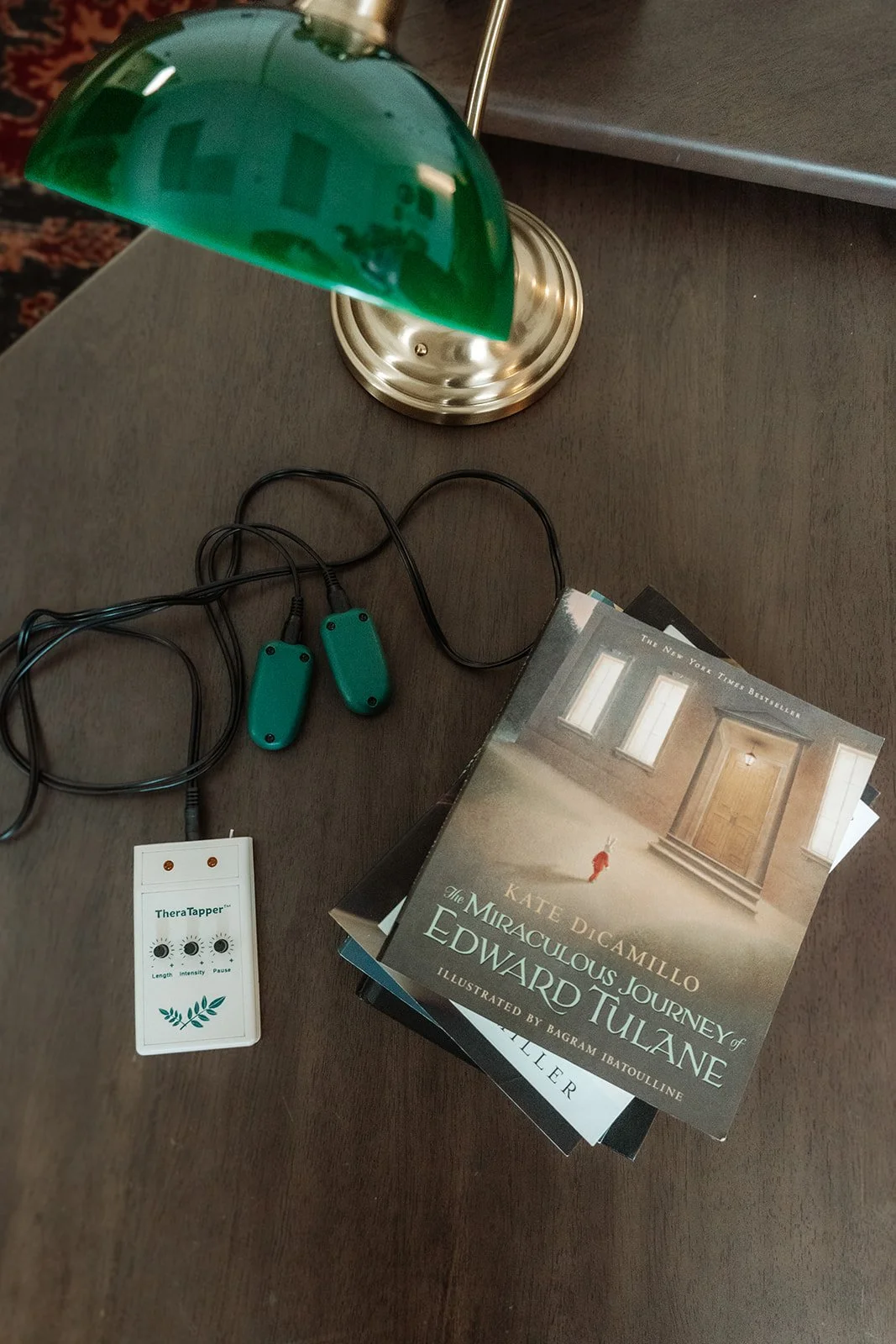
![Therapy office with Theratapper bilateral stimulation device and books, EMDR intensive therapy Flagstaff Arizona]()
Intensive Therapy
For when weekly therapy isn’t enough, intensives can compress months of healing into focused, extended sessions designed for deep and lasting change.



Frequently Asked Questions
-
No. This is one of the things that sets the approaches I use apart from traditional talk therapy. EMDR, ART, and other trauma-focused modalities don’t require you to narrate every detail. We work with what your nervous system is holding, which means you can do meaningful healing without reliving every moment.
-
There is a good chance and here’s why - A lot of trauma survivors have spent years in talk therapy, built a lot of insight, and still feel like something hasn’t shifted at the root. That’s usually because talk therapy alone doesn’t reach the level where trauma actually lives. The approaches I use are specifically designed to go deeper than insight and create change at the nervous system level. If previous therapy felt like it only scratched the surface, this work tends to feel very different.
-
I work with a full spectrum - single incident trauma, complex trauma, childhood trauma, and attachment trauma. A lot of my clients come in carrying years of relational wounding, chronic emotional neglect, or patterns that started long before they had words for them. Whether you can point to one specific event or your trauma is harder to name, we can work with it.
-
It depends on what you’re working on and how your nervous system responds. Some clients make significant progress in a few months, especially with approaches like EMDR and ART accelerating the processing. Others choose to work longer when we’re addressing deep, complex, or attachment trauma. We’ll talk about realistic expectations early on and check in regularly to make sure we’re moving in the right direction.
-
No. Trauma isn’t defined by how extreme an event was. It’s defined by how your nervous system responds to it. Years of feeling unseen, unsafe, or not enough can be just as impactful as a single major event, sometimes more so because it’s harder to point to and name. If something from your past is still affecting how you feel, relate, or see yourself - it’s worth addressing.
-
Talk therapy helps you understand your trauma - where it came from, how it shaped you, what patterns it created. EMDR goes a step further by helping your brain actually reprocess the memory itself, so it stops carrying the same emotional charge. EMDR is what helps that insight translate into an actual shift in your lived experience.
-
Finding the right fit matters more than finding the closest office. Look for someone trained in trauma-specific approaches like EMDR. Training and experience matter for trauma work, but just as important is the relationship itself. Research consistently shows that the therapeutic relationship is one of the biggest predictors of how well therapy actually works, so you’re looking for someone whose training you trust and who you genuinely feel connected to. A free consultation is always a good way to gauge both. You should walk away from a consultation call feeling like they understand what you’re describing, and like you could actually be yourself in the room with them.
-
Yes, I offer trauma therapy to clients throughout Arizona via secure telehealth, including Flagstaff and the surrounding Northern Arizona area. You don’t need to travel to Scottsdale to access specialized trauma care. As long as you’re located in Arizona at the time of our session, we can work together.
-
Absolutely. Research consistently shows that telehealth therapy is just as effective as in-person sessions for trauma treatment. Many clients actually find they open up more easily from the comfort of their own home. Living in a smaller community like Flagstaff shouldn’t limit your access to specialized, evidence-based trauma care - and with telehealth, it doesn’t have to.
You deserve to feel connected, grounded, and at home in your life.
This work is worth it, and I’d be honored to do it with you.
*If you’re in Flagstaff or anywhere in Northern Arizona and have been searching for specialized trauma therapy, you don’t have to keep looking. Accessing a Certified EMDR Therapist who specializes in complex trauma, attachment wounding, and advanced trauma modalities is possible from wherever you are in Arizona.
Trauma Therapy in Flagstaff, Arizona
Serving Flagstaff and all of Arizona via telehealth